What is ORIS and Its Innovative Approach?
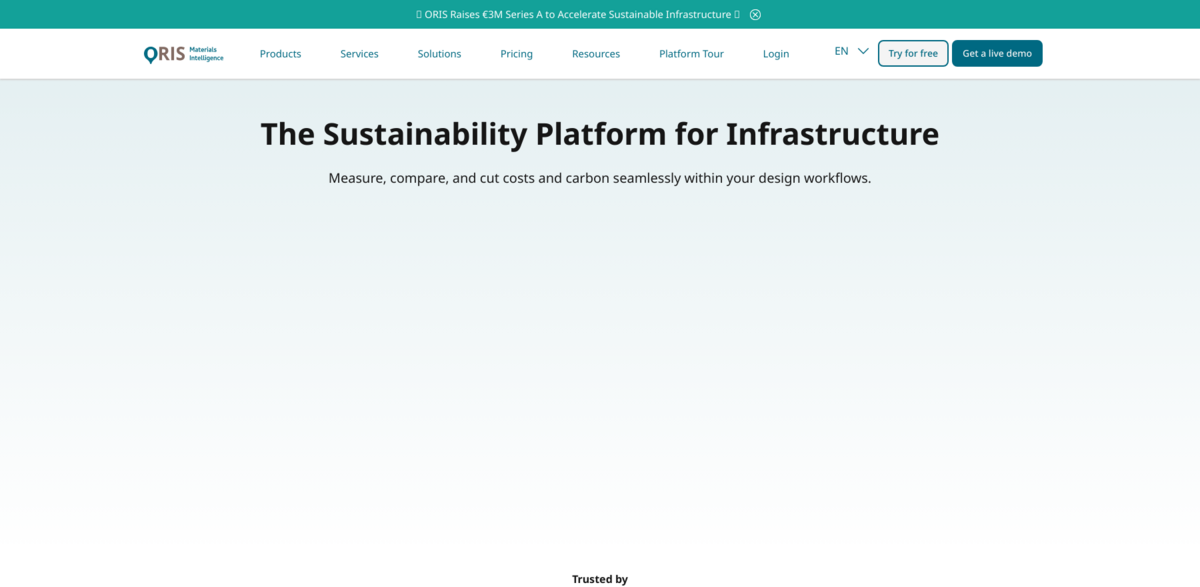
ORIS is a mission-driven company aiming at digitizing the construction materials sector, reducing the environmental impact of infrastructure, contributing to inclusive transport networks, and building equitable, balanced growth. The platform gathers materials, information, and knowledge worldwide to make them accessible to all stakeholders in the industry, so that relevant data and multiple scenarios can be used to make informed decisions. ORIS was designed with one goal in mind: to place carbon assessment at the heart of infrastructure design… transforming standard practices with accurate, quick insights while aligning with environmental regulations.
Main Benefits and Key Figures
- 3.1 million tons of CO₂eq reduction levers identified in 2024
- Equivalent of taking 964,000 cars off the road for one year
- Accelerates carbon assessment iterations for infrastructure by up to 8 times
- Identified levers that enable the reduction of carbon dioxide equivalent emissions by 8,000 tons in evaluated projects
- Consolidates cost, carbon, and material data into a single source of truth
Seamless Integration with Existing Workflows
ORIS integrates effortlessly with current tools, ensuring that companies obtain quick and reliable data on carbon calculations and cost reductions in production. The platform’s design transforms complex calculations into clear, accurate insights, significantly enhancing time-to-market. Thanks to its cloud-based structure, ORIS bridges the gap between standardized designs and local material availability. By adopting a new ecosystem approach, it makes sourcing evaluations less daunting and more data-driven, thereby not only ensuring compliance but also offering a competitive edge.
Comprehensive Carbon Footprint Assessment
Built for multi-country, multi-discipline deployment, the comprehensive ORIS platform combines functionalities similar to aspect and NH into one all-in-one solution. It transforms intricate assessments into quick, reliable results while maintaining consistency across teams, countries, and disciplines. A striking example of its capability is the Autobahn project, where a comprehensive evaluation of 13 distinct projects led to identifying measures that enabled an 8,000-ton reduction in carbon dioxide equivalent emissions. ORIS makes complex scenarios understandable… and this sets a new benchmark for how carbon footprint evaluations should be done.
Data Integrity and Verified Methods
The system leverages verified datasets, including national databases and the ecoinvent database, to establish trusted inputs for carbon assessment. An independent assurance statement by Intertek validates the methodology employed in ORIS’s carbon footprint calculation models, affirming its dedication to both environmental and data security standards. In a world where precision matters, such validations and integrations ensure that data integrity is not compromised, paving the way for reliable, jurisdiction-specific, and compliance-ready dashboards. This meticulous approach ensures every calculation stands up to rigorous scrutiny.
Project Impact on Sustainable Development Goals
- SDG 9: Industry, Innovation, and Infrastructure
- SDG 11: Sustainable Cities and Communities
- SDG 12: Responsible Consumption and Production
- SDG 13: Climate Action
Transforming the Future of Infrastructure
ORIS provides the keys to lead a transformation in infrastructure sustainability. By consolidating cost, carbon, and material data and integrating seamlessly with existing workflows, it offers a dynamic solution that helps build a culture where carbon assessment is not an afterthought but a key design criterion. With the innovative approach of using local resources based on circularity, natural resource usage in infrastructure construction can be reduced by up to 80% while simultaneously diminishing the overall carbon footprint. This forward-thinking platform not only supports corporate commitments with measurable impact but also sets the industry standard for consistent, reportable, and scalable solutions. As infrastructure stakeholders adapt to these dynamic changes, ORIS stands at the forefront, illuminating the path to sustainable and responsible growth…
What ORIS Materials Intelligence actually does
ORIS Materials Intelligence builds a carbon and material-cost intelligence platform for linear transportation infrastructure (roads and rail), integrating directly into BIM design tools like Autodesk Civil 3D and Revit to run life-cycle carbon assessments during design rather than after.
“Using the ORIS platform, we identified a solution that achieved a 15% reduction in carbon footprint (nearly 1 million kg CO2 eq.), saved 0.87 million pounds, and reduced material consumption by 14.6 thousand tonnes.”
James Burdall, Head of Pavement Design and Asset Management, AECOM
Where the platform is used
- Infrastructure design and construction: used by Holcim, Arcadis, Egis, Sweco, AECOM and Bouygues Construction
- National road authorities: including Autobahn (Germany), DB and the Welsh Government
- BIM integration: a certified Autodesk partner, embedding carbon analysis directly into Civil 3D and Revit workflows
Proof, not just claims
Trusted by
AECOMEngineering
SwecoEngineering
AutobahnGerman road authority
RambollEngineering
Why this belongs on a sustainability directory
ORIS’s platform is independently verified through Intertek LCA assurance and directly credited by named clients with specific, measured outcomes, including AECOM’s 15% carbon reduction on a real project and Autobahn’s 8,000-ton CO2 equivalent reduction, a direct SDG 9 (Industry, Innovation and Infrastructure) case grounded in project-level, attributed results rather than platform-wide marketing claims.
Frequently asked questions
Who uses ORIS Materials Intelligence?
ORIS is used by infrastructure firms and road authorities including Holcim, AECOM, Sweco, Autobahn (Germany), Ramboll and Bouygues Construction to run carbon assessments on roads and rail projects.
Which SDGs does ORIS support, and how?
SDG 9 (Industry, Innovation and Infrastructure) and SDG 12 (Responsible Consumption and Production), by identifying 3.1 million tons of CO2eq reduction across infrastructure projects in 2024, with individual client results including AECOM’s 15% carbon reduction on a pavement design project.
How is ORIS verified as a sustainability project?
ORIS holds ISO 27001 and SOC 2 Type II certifications, complies with CSRD/CPR and ISO 15804/21930/14067 standards, and its life-cycle assessments carry independent Intertek assurance.
Looking for similar clean technology projects?
See Clean Technology projects on Keys for Tomorrow.