What CarbonCloud actually does
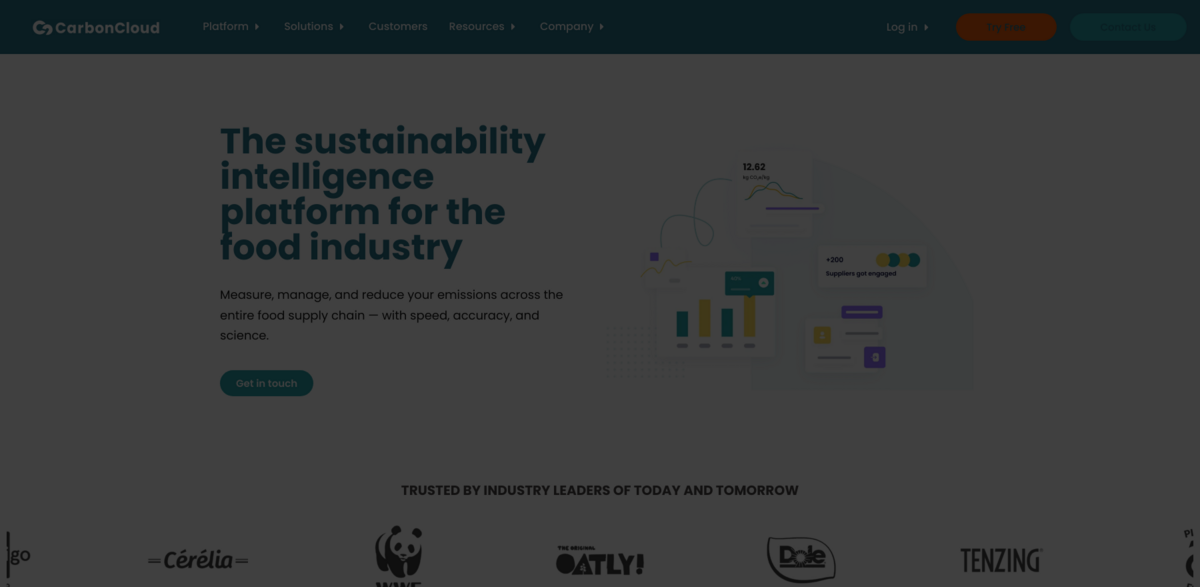
CarbonCloud is a carbon accounting platform built specifically for the food industry: it calculates Scope 3 emissions across a food company’s entire supply chain, automates supplier data collection, and produces audit-ready product carbon footprints aligned with the GHG Protocol and ISO 14067. Founded by climate scientists in Gothenburg, Sweden, it runs on what the company describes as the world’s largest food-specific carbon footprint dataset.
“We decided to calculate the climate footprint of our products with CarbonCloud, to focus on the number that drives the food system change.”
Sustainability Manager, Oatly
Where the emissions data comes from
- Automated Scope 3 calculations: AI-matched against a proprietary emissions-factor database, refined continuously with real supplier data
- Supplier engagement: automated outreach and data-validation workflows instead of manual spreadsheets
- Product carbon footprints: calculated from a company’s own bill of materials, with carbon labels ready to publish
- SBTi FLAG reporting: baseline tracking and reduction targets built for food and agriculture’s specific science-based target framework
Trusted by
DoleFood & produce
WWFConservation
SystembolagetRetail
TenzingBeverages
Planet A FoodsFood tech
CarbonCloud does not publish aggregate reduction percentages, so this page leads with who actually uses the platform in production rather than an invented headline number.
Why food supply chains specifically
Multi-tiered agricultural supply chains are notoriously hard to measure: a single food product can carry emissions from dozens of farms, processors and shippers before it reaches a shelf. CarbonCloud’s AI engine matches a company’s product portfolio against its emissions database to give calculation control “from farm to shelf,” rather than the industry-average estimates most carbon accounting tools fall back on for food.
Why this belongs on a sustainability directory
Food systems account for close to a third of global greenhouse gas emissions, and most of it sits in Scope 3, outside any single company’s direct control. Tools that make supplier-level emissions data collectible and auditable are what let food companies set real science-based targets instead of estimates. That is the concrete link between CarbonCloud’s product and SDG 12 (Responsible Consumption and Production) and SDG 13 (Climate Action), the two SDGs actually tagged on this project.
Frequently asked questions
Where is CarbonCloud based, and who uses it?
CarbonCloud is headquartered in Gothenburg, Sweden, and sells B2B to food and beverage companies managing supply-chain emissions, including Oatly, Dole, WWF and Systembolaget.
Which SDGs does CarbonCloud support, and how?
SDG 12 (Responsible Consumption and Production) through audit-ready product carbon footprints, and SDG 13 (Climate Action) by giving food companies the supplier-level data needed to set science-based emissions targets.
How is CarbonCloud verified as a sustainability project?
CarbonCloud holds the Solar Impulse Foundation’s “Efficient Solution” label, cross-referenced by Keys for Tomorrow against the Foundation’s own database of vetted clean technologies.
Looking for similar carbon accounting or food-tech projects?
See other Food & Beverage projects, or browse all SDG 13: Climate Action projects.