
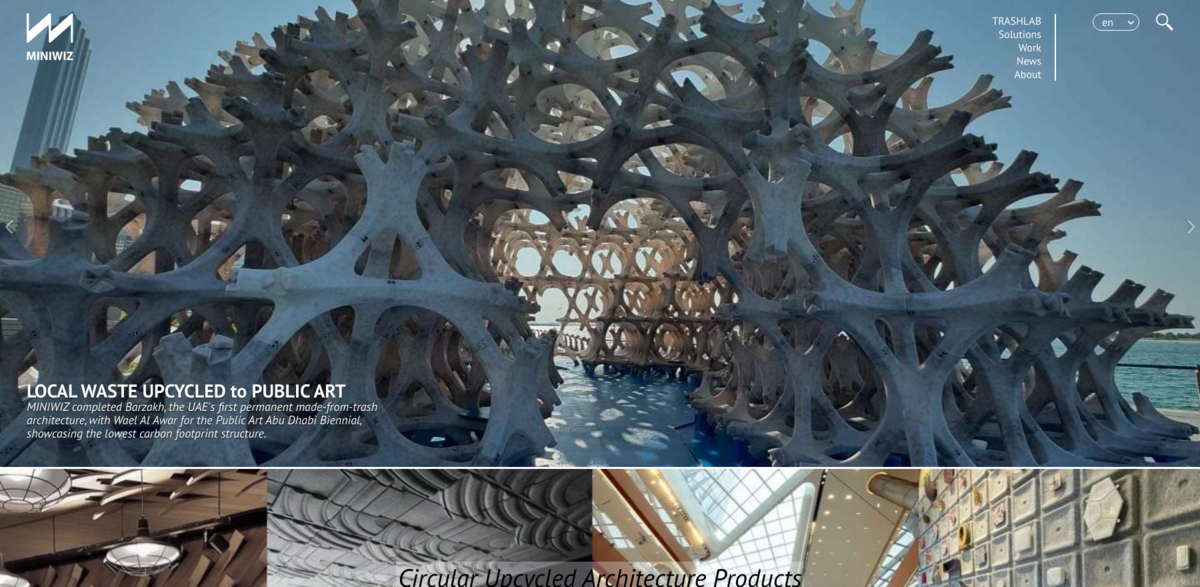
MINIWIZ’s Barzakh: UAE’s First Permanent Trash Architecture
MINIWIZ completed Barzakh, the UAE’s first permanent made-from-trash architecture, teaming up with Wael Al Awar for the Public Art Abu Dhabi Biennial. This project showcases the lowest carbon footprint structure, turning waste into a lasting, impactful piece of architecture. It’s not just a building—it’s a statement about sustainability and innovation in design.
Main Benefits of MINIWIZ’s Eco Innovations
Here’s what makes MINIWIZ projects stand out:
- Barzakh: The lowest carbon footprint structure in the UAE.
- EcoARK Museum: 9 stories tall, built for the 2010 International Flora Expo in Taipei, with a 90% carbon footprint saving.
- TRASHPRESSO: A mobile trash upcycling system that transforms local waste into high-value building products without secondary pollution.
- Hospital ICUs: Smart, pandemic-ready modular wards designed with upcycled “hospital grade” materials, adaptable to various medical needs.
- HOUSE OF TRASH: Fashion waste transformed into artful home furnishings, designed and manufactured for Milan’s design scene.
- NIKE Partnership: ESG specialty ODM contractor turning circular retail design visions into reality through trash material innovation and modular engineering.
Transforming Healthcare with Modular Pandemic-Ready ICUs
MINIWIZ turned waste pollution into an eco-medical solution of the future by designing, engineering, manufacturing, and building smart pandemic-ready ICUs for Fu Jen Catholic University Hospital in Taipei. This modular ward concept, developed in partnership with Taiwan’s Ministry of Economic Affairs and Taiwan Design Research Institute, is designed to quickly transform buildings and underutilized spaces into ICU, general, or isolation wards, adapting to market demand. It’s a flexible, sustainable response to healthcare challenges.
Innovative Features of MINIWIZ’s Modular Ward System
The system boasts some pretty impressive features:
- State-of-the-art design: A building kit with interlocking parts, drawing on 15 years of modular design experience.
- COVID-19 ready: Negatively pressurized clean rooms to control biocontamination risks.
- Eco-friendly materials: Maximizes use of post-consumer single-use materials like aluminum cans and PET bottles.
- Soothing ambiance: Smart lights, sound absorption panels, and visually calming artwork to lift patients’ mood and reduce stress.
MINIWIZ’s Commitment to R&D and Antiviral Solutions
Since the COVID-19 pandemic, MINIWIZ has heavily invested in research and development to create products that combat bacteria and viruses. Their first product, an antiviral acoustic wall panel, is already deployed in the modular wards. And it doesn’t stop there—using similar technology and design, MINIWIZ expects these solutions to appear in restaurants, hotels, and even consumer spaces later this year. It’s innovation that’s ready to roll out beyond hospitals.
Project Impact: Sustainable Development Goals (SDGs) Linked to MINIWIZ Projects
- SDG 3: Good Health and Well-being – through pandemic-ready medical infrastructure.
- SDG 9: Industry, Innovation, and Infrastructure – via modular design and upcycling technology.
- SDG 11: Sustainable Cities and Communities – by creating eco-friendly, low-carbon footprint buildings.
- SDG 12: Responsible Consumption and Production – through waste upcycling and circular design.
- SDG 13: Climate Action – by drastically reducing carbon footprints in construction and manufacturing.
MINIWIZ’s Vision for a Circular and Sustainable Future
MINIWIZ isn’t just about creating products; it’s about rethinking how materials and design can work together to solve global challenges. From transforming single-use fashion waste into beautiful home furnishings at HOUSE OF TRASH in Milan, to partnering with NIKE to bring circular retail design to life, MINIWIZ is pushing the boundaries of what’s possible. Their proprietary upcycling machinery and modular systems show a clear path forward—one where waste becomes a resource, and sustainability is built into every step of the process.
What MINIWIZ actually does
MINIWIZ, founded in Taipei, Taiwan in 2005 by architect and engineer Arthur Huang, develops technologies and materials that transform waste into structural building products, then designs and builds architecture from those materials rather than treating waste-to-material conversion and construction as separate businesses.
Where the technology shows up
- Public architecture: the EcoARK museum, built for Taipei’s 2010 International Flora Expo
- Healthcare infrastructure: modular ICU units for FJ Catholic University Hospital in Taipei
- International collaborations: the Barzakh structure in Abu Dhabi with architect Wael Al Awar, and consumer product work as an ESG specialty contractor for NIKE
Proof, not just claims
MINIWIZ also works with NIKE as an ESG specialty contractor and has deployed projects at high altitude on the Tibetan plateau.
Trusted by
FJ Catholic University HospitalModular ICU units
Why this belongs on a sustainability directory
MINIWIZ’s core technology converts waste materials into structural building products, verified on real projects like the EcoARK museum’s measured 90% carbon footprint reduction, a direct SDG 12 (Responsible Consumption and Production) case. Its modular ICU work for hospitals, built from the same waste-derived materials, extends that model into healthcare infrastructure, connecting to SDG 3 (Good Health and Well-being).
Frequently asked questions
Where is MINIWIZ based, and who uses it?
MINIWIZ is based in Taipei, Taiwan, founded in 2005 by Arthur Huang, and works with clients and collaborators including NIKE, FJ Catholic University Hospital, and architect Wael Al Awar on the Barzakh project in Abu Dhabi.
Which SDGs does MINIWIZ support, and how?
SDG 12 (Responsible Consumption and Production), by converting waste into structural building materials, and SDG 3 (Good Health and Well-being), through modular healthcare infrastructure such as its ICU units built from those same materials.
How is MINIWIZ verified as a sustainability project?
MINIWIZ’s EcoARK museum project has a documented lifecycle assessment showing a 90% carbon footprint saving; the company does not list a separate third-party sustainability certification on its site.
Looking for similar health and well-being projects?
See Health & Well-being projects on Keys for Tomorrow.