What is Bloom?
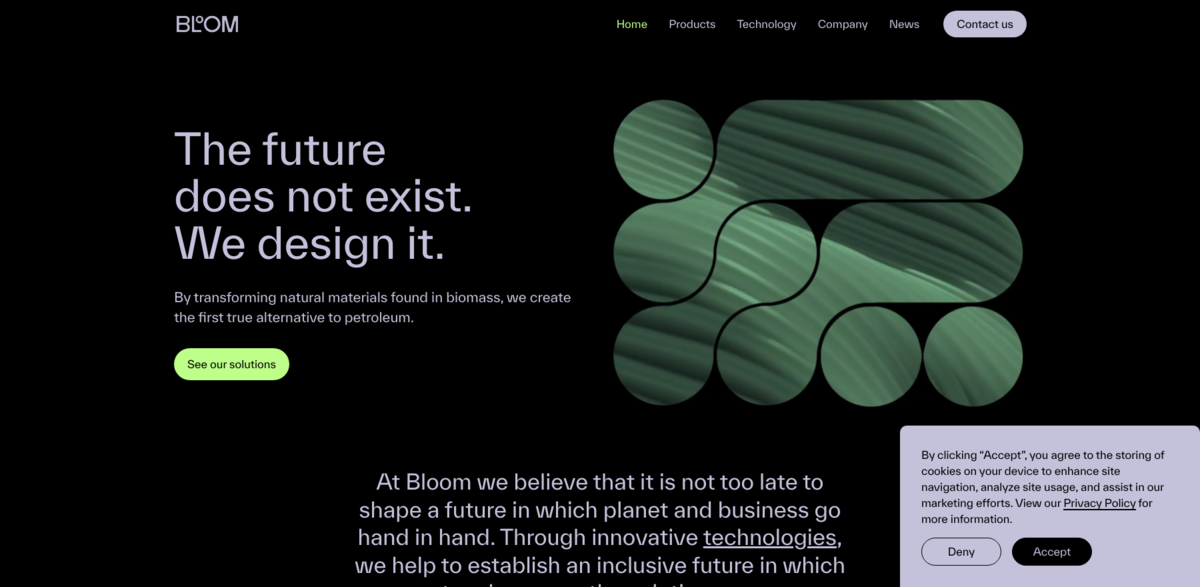
Bloom is a chemical company that’s shaking things up by mining high-value chemicals from agroforestry wastes with unprecedented efficiency. The goal? To provide a cost-competitive, renewable alternative to fossil fuels. By transforming natural materials found in biomass, Bloom creates the first true alternative to petroleum. It’s not just about business — it’s about shaping a future where the planet and industry go hand in hand. Through innovative technologies, Bloom is helping to build an inclusive future where nature itself becomes the solution space.
Main Benefits of Bloom’s Approach
Bloom’s work isn’t just talk — the impact is measurable and impressive:
- Zero compromise on quality
- 80% reduction in CO2 emissions
- 3 million tons of CO2 avoided
These figures highlight how Bloom’s technology makes biomass count, turning what was once waste into valuable, sustainable resources.
Fields of Application: Cosmetics & Homecare
Bloom’s lignin products bring endless opportunities to the cosmetics and homecare industries. They offer antioxidant properties, act as UV filters, and have antimicrobial and antiviral effects. Plus, they’re water-soluble and work as excellent emulsifiers and dispersants — all effective even in low concentrations. This means safer, greener ingredients for everyday products.
Fields of Application: Specialty Cellulose
When it comes to specialty cellulose, Bloom offers sustainable, degradable bioplastics like polyester and polyurethane. These materials don’t just perform well mechanically; they also provide excellent barrier properties and can be chemically recycled even from mixtures. It’s a big step toward reducing plastic waste and promoting circularity in materials.
Fields of Application: Materials and Additives
Similar to specialty cellulose, Bloom’s materials and additives focus on sustainable, degradable bioplastics. These bioplastics boast excellent mechanical and barrier properties and are chemically recyclable from mixtures. This innovation supports industries looking to replace traditional plastics with greener alternatives without sacrificing performance.
Project Impact: Sustainable Development Goals (SDGs)
- SDG 7: Affordable and Clean Energy
- SDG 9: Industry, Innovation, and Infrastructure
- SDG 12: Responsible Consumption and Production
- SDG 13: Climate Action
- SDG 15: Life on Land
Bloom’s technology aligns with multiple SDGs, emphasizing clean energy, innovation, sustainable production, climate action, and protecting terrestrial ecosystems.
Fields of Application: Solvents
Bloom’s lignin products also show great promise in the solvents sector, particularly for heavy fuel oil and sustainable aviation fuels (SAFs). This opens up new pathways for greener fuels in industries that are traditionally hard to decarbonize, pushing the boundaries of what renewable resources can achieve.
What Bloom Biorenewables actually does
Bloom Biorenewables is a Swiss chemicals company based in Marly, founded in 2019, that converts wood residues into performance ingredients for the personal care, functional paper, and paints and coatings industries. Its process fractionates wood residue into usable components rather than treating it as waste, replacing petrochemical inputs with agroforestry byproducts.
Where the technology shows up
- Personal care: PRIMAA White Lignin, used as a UV booster, antioxidant, and BPA replacement.
- Industrial chemistry: Dipropylxylose (DPX), a solvent, emollient, humectant, and plasticizer derived from wood residue.
- Paper and coatings: microfibrillated celluloses used as rheology modifiers, film-formers, and barrier coatings.
Proof, not just claims
Bloom describes its White Lignin as the world’s first product of its kind, and its microfibrillated cellulose as the industry’s highest-solids readily redispersible product on the market.
Backed by
Valquestinvestor
Anaïs Venturesinvestor
Why this belongs on a sustainability directory
Bloom Biorenewables connects to SDG 12 (responsible consumption and production) by converting agroforestry waste into performance chemicals instead of virgin petrochemical inputs, and to SDG 13 (climate action) through its claimed 80% reduction in CO2 emissions versus conventional chemical production.
Frequently asked questions
Where is Bloom Biorenewables based, and who uses it?
Bloom Biorenewables is based in Marly, Switzerland, founded in 2019. It sells performance chemical ingredients to the personal care, functional paper, and paints and coatings industries.
Which SDGs does Bloom Biorenewables support, and how?
Bloom Biorenewables supports SDG 12 (responsible consumption and production) by turning wood residue into performance chemicals, and SDG 13 (climate action) through a process it says cuts CO2 emissions by 80% versus conventional chemical production.
How is Bloom Biorenewables verified as a sustainability project?
Bloom Biorenewables holds Solar Impulse Efficient Solution certification and is backed by climate-focused investors including Breakthrough Energy.
Looking for similar Energy projects?
See Energy projects on Keys for Tomorrow.