What is Pocket Science?
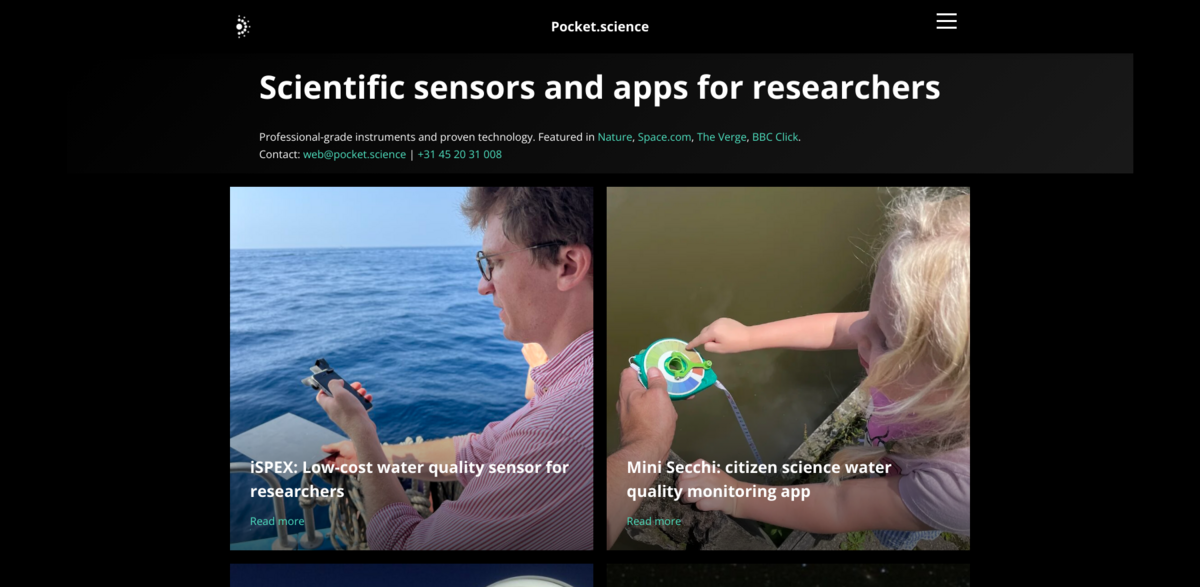
Pocket Science is all about bringing professional-grade scientific sensors and apps right to your fingertips. Imagine turning your smartphone into a powerful research tool—well, that’s exactly what Pocket Science does. With a focus on low-cost, high-quality instruments, this project empowers researchers and citizen scientists alike to dive deep into environmental monitoring. Featured in top outlets like Nature, Space.com, The Verge, and BBC Click, Pocket Science is making waves by combining proven technology with accessibility.
The Main Benefit: Affordable, Accurate Water Quality Monitoring
At the heart of Pocket Science is the iSPEX2, a smartphone add-on that transforms your device into a research-grade spectropolarimeter. This means you can measure water quality with precision that rivals equipment costing tens of thousands of euros. Here are some key facts that highlight its impact:
- Validated by Plymouth Marine Laboratory with 70% of smartphone spectra successfully converted to remote reflectance (Rrs).
- iSPEX2’s remote reflectance measurements are benchmarked against SoRad instrumentation, ensuring top-notch accuracy.
- Uses SPEX spectropolarimetry technology, the same tech deployed on NASA’s PACE satellite mission.
- Currently shipping worldwide to research groups and citizen science campaigns.
- Enables large-scale environmental monitoring, from algae blooms to sediment and pollution detection.
Understanding Remote Reflectance (Rrs)
So, what exactly is remote reflectance, or Rrs? It’s often called the “gold standard” in water quality science. Basically, Rrs measures how much light bounces off water at different wavelengths, revealing what’s in that water—whether it’s algae, sediment, or pollutants. Getting accurate Rrs data used to require expensive, bulky equipment, but iSPEX2 has cracked the code, making this crucial measurement accessible to researchers and citizen scientists alike.
The Technology Behind iSPEX
iSPEX2 leverages SPEX spectropolarimetry technology, which isn’t just cutting-edge—it’s space-grade. This same technology is used on NASA’s PACE satellite mission, which means iSPEX2 isn’t just a gadget; it’s a serious scientific instrument. This shared methodology allows iSPEX2 to serve as a validation tool for satellite observations, bridging the gap between ground-level data and global environmental monitoring.
Current Research and Citizen Science Applications
iSPEX2 is already making a difference in the hands of leading research institutions worldwide. Groups like the LandSeaLot Consortium are using it for ocean color validation studies, while Plankton Planet at the University of Maine monitors marine ecosystems. Other users include Vrije Universiteit Brussel, Leiden University, and Sorbonne University’s Mission Bougainville, all leveraging iSPEX2 for environmental sensing and oceanographic research. Plus, with over a decade of experience in citizen science, Pocket Science supports large-scale campaigns that empower everyday people to contribute valuable data on water quality and environmental health.
Impact on Sustainable Development Goals (SDGs)
- SDG 6: Clean Water and Sanitation – by enabling precise water quality monitoring.
- SDG 13: Climate Action – through improved environmental data supporting climate research.
- SDG 14: Life Below Water – by tracking ocean health and pollution.
- SDG 15: Life on Land – through monitoring freshwater ecosystems and pollution.
- SDG 17: Partnerships for the Goals – fostering collaboration between researchers, citizen scientists, and institutions worldwide.
The Team Behind Pocket Science
The brains and hands behind Pocket Science include Norbert Schmidt and Joep van der Heiden of DDQ Pocket Science, with hardware design and early production by Armand Perduijn. They collaborate closely with experts like Stefan Simis and Tom Jordan from Plymouth Marine Lab, as well as Frans Snik and Olivier Burggraaff from Leiden University. This tight-knit team combines expertise in hardware, software, and environmental science to keep pushing the boundaries of what smartphone-based research can achieve.
What Pocket Science actually does
Pocket Science (DDQ B.V.), founded in 2020 and based in Heerlen, Netherlands, builds iSPEX2, a portable smartphone attachment that turns a phone into a research-grade water-reflectance sensor for water color and quality science. The tool traces back to iSPEX, a citizen-science project originating at Leiden University.
Where the validation comes from
- Plymouth Marine Laboratory: Prof. Stefan Simis and Dr. Tom Jordan validated iSPEX2 against professional reference instruments (WISP-3, So-Rad, TriOS-RAMSES) in 2025 field campaigns
- Leiden University: origin of the iSPEX citizen-science lineage the tool builds on
Proof, not just claims
Trusted by
Leiden UniversityiSPEX research lineage
Why this belongs on a sustainability directory
Pocket Science’s iSPEX2 gives researchers and citizen scientists an affordable way to measure water quality indicators directly, a direct SDG 6 (Clean Water and Sanitation) case, validated by an independent marine research institute rather than self-reported claims alone.
Frequently asked questions
Where is Pocket Science based, and what do they make?
Pocket Science (DDQ B.V.) is based in Heerlen, Netherlands, founded in 2020, and makes iSPEX2, a smartphone attachment that measures water reflectance for water quality science.
Which SDG does Pocket Science support, and how?
SDG 6 (Clean Water and Sanitation), by giving researchers and citizen scientists an affordable, portable tool to measure water quality indicators.
How is iSPEX2 verified as accurate?
It was validated against professional reference instruments by Plymouth Marine Laboratory researchers Prof. Stefan Simis and Dr. Tom Jordan in 2025 field campaigns.
Looking for similar water management projects?
See Water management projects on Keys for Tomorrow.