What is Aquascope?
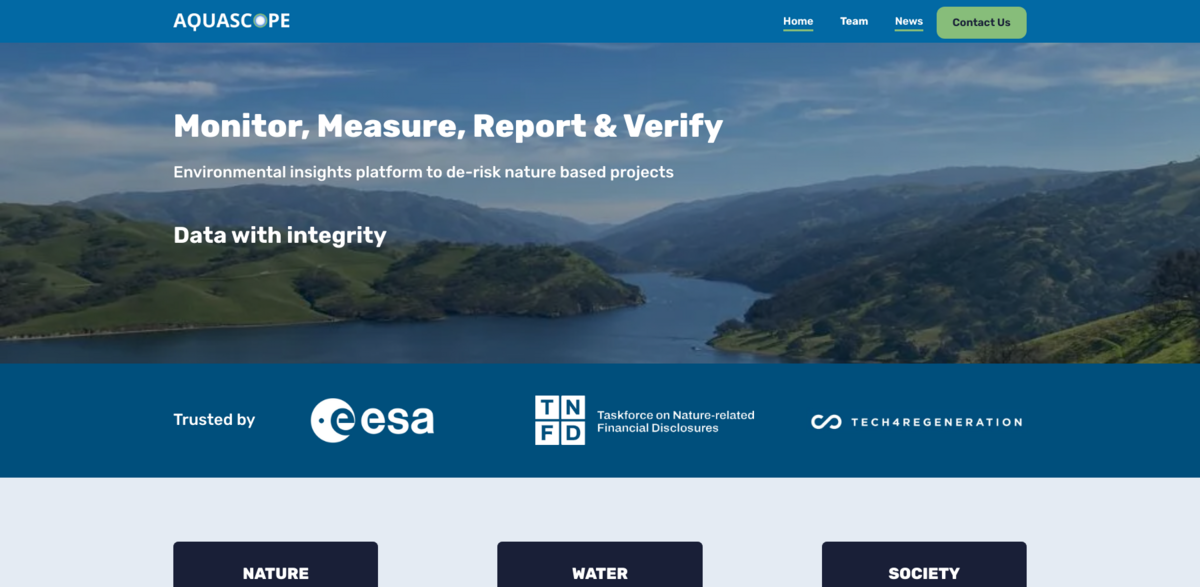
Aquascope is an environmental insights platform designed to monitor, measure, report, and verify nature-based projects with integrity. It focuses on de-risking investments in carbon, water, and biodiversity by providing connected impact metrics that track ecosystem health. In a world where carbon markets and environmental regulations are evolving rapidly, Aquascope offers a powerful toolset to measure carbon sequestration, water quality and quantity, and biodiversity impacts. The platform helps users run scenarios on land use changes and nature-based mitigations, generating clear, measurable data that supports transparent decision-making and robust impact-driven markets.
Main Benefits of Aquascope
By using Aquascope, businesses, investors, and governments gain access to reliable data that drives smarter environmental and financial decisions. Here are some key features and facts:
- Run multiple scenarios on land use and mitigation strategies to see measurable effects on carbon, water, and biodiversity.
- Generate automated annual reports that provide evidence for disclosures, regulatory compliance, or financial credit reporting.
- Baseline assessments of water quality and quantity to build a solid foundation for planning and investment.
- Live monitoring and forecasting of water flows and quality, with advanced warnings of seasonal changes.
- Independent social impact metrics covering community well-being, economic development, education, and policy support.
- Integration of local and global models backed by over 35 years of research and proven in more than 120 river catchments.
- API-first approach enabling real-time data integration into existing systems and software.
Water Resource Management with Aquascope
Water resources are becoming increasingly unstable due to climate change and human activities. Aquascope addresses this challenge by offering tools for short, medium, and long-term water resource planning. It helps protect both upstream and downstream ecosystems by providing baseline assessments, scenario planning, and continuous monitoring. This means industries and communities can better quantify the value of integrated water management projects, supporting climate resilience and adaptation strategies. The platform’s live data and forecasts allow users to anticipate changes and make informed decisions that safeguard water availability and quality.
Supporting Nature and Biodiversity
Aquascope connects carbon, water, and biodiversity metrics to provide a comprehensive picture of ecosystem health. This holistic approach builds trust in nature-based carbon markets by ensuring data integrity and transparency. Users can simulate the impact of land use changes and nature-based mitigations, helping to scale high-integrity credits and contributions. The platform’s ability to combine satellite data, machine learning, and local knowledge ensures timely and accurate observations of environmental changes, empowering stakeholders to protect and restore natural habitats effectively.
Enhancing Social Impact and Community Value
Beyond environmental data, Aquascope measures the social benefits of regeneration and conservation projects. It tracks improvements in community health, recreation, and overall quality of life. Economic impacts such as job creation, tourism growth, and increased property values are also monitored. Additionally, the platform assesses educational outcomes and supports policy and planning efforts with robust, independent data. This comprehensive social impact measurement helps ensure that nature-based projects deliver real value to local economies and communities, fostering transparency and trust.
Project Impact and Sustainable Development Goals (SDGs)
- SDG 6: Clean Water and Sanitation – by improving water quality and availability.
- SDG 13: Climate Action – through accurate carbon sequestration measurement and mitigation planning.
- SDG 15: Life on Land – by monitoring biodiversity and supporting ecosystem health.
- SDG 8: Decent Work and Economic Growth – via tracking economic benefits from conservation projects.
- SDG 11: Sustainable Cities and Communities – through enhancing community well-being and resilience.
How Aquascope Delivers Its Solutions
Aquascope combines cutting-edge technology with decades of expertise to deliver actionable insights. Its API-first design allows seamless integration of carbon, water, and related data into existing software systems, providing real-time updates. Customized dashboards offer decision-ready visuals to monitor performance, identify risks, and set alerts. The platform leverages a unique blend of process-based models, satellite remote sensing, machine learning, and site sampling to ensure data accuracy and timeliness. Connected sensors and in-situ sampling calibrate and validate data, maintaining precision and trustworthiness. This integrated systems approach helps customers align stakeholders within the same geography, enabling faster, more accurate, and sustainable decision-making.
What Aquascope actually does
Aquascope is an environmental intelligence platform that uses freshwater as a diagnostic indicator of ecosystem health. It combines catchment models, satellite data, weather data and sensor or sampled measurements to give land managers, investors and water users continuous data on flow, temperature, dissolved oxygen, nitrogen, phosphorus, sediment, dissolved carbon, pathogens and phytoplankton across whole river catchments.
The platform works in four layers: baseline landscape modelling of current and historical conditions, future land use and emission scenario planning, continuous sensor-agnostic monitoring, and daily water quality and flow forecasts. Its scientific core is the INCA modelling framework developed by Prof. Paul Whitehead of the University of Oxford, Aquascope’s Chief Scientific Advisor. R&D with the European Space Agency has extended it into monitoring, reporting and verification (MRV) for wetland carbon projects and Volumetric Water Benefit Accounting (VWBA 2.0).
Where Aquascope shows up
- Water utilities: monitoring catchment condition and forecasting water quality risks to protect upstream supplies and cut treatment costs.
- Corporates: quantifying the downstream impact of sites and supply chains to back water stewardship and conservation projects.
- Nature and carbon project developers: integrated carbon, water and biodiversity MRV for wetlands, peatlands and mixed habitats.
- Public sector and NGOs: decision support for catchment planning, water policy and citizen science.
Proof, not just claims
Published case studies include a catchment-scale modelling baseline for WWF-UK across the Wye, Cleddau, Stiffkey and Glaven rivers, a daily water quality forecasting system for the Thames basin with five-day forecasts, and a carbon and water MRV baseline for wetlands in Slovenia’s Notranjska Regional Park. In Jamaica, it built a decision support system for Kingston’s water security embedded in government workflows.
Trusted by
Northumbrian WaterBlackwater catchment commercial pilot
Nestlé UKColne catchment pollution modelling
Anglian WaterColne catchment pollution modelling
European Space AgencyR&D partner
Carbon ClearWetland carbon MRV partner
Why this belongs on a sustainability directory
Freshwater systems are degrading faster than forests or oceans, yet most organisations only screen for water risk instead of measuring the actual condition of the rivers they depend on. Aquascope turns daily nutrient, oxygen, flow and pathogen data into baselines and forecasts that utilities, companies and regulators can act on. That links it directly to SDG 6 (Clean Water and Sanitation) through catchment-scale water quality monitoring and pollution forecasting, SDG 13 (Climate Action) through verifiable carbon accounting for wetland projects, and SDG 15 (Life on Land) through measurement of ecosystem and biodiversity outcomes of restoration.
Frequently asked questions
Where is Aquascope based, and who uses it?
Aquascope is headquartered in Lausanne, Switzerland, according to the Solar Impulse Foundation, and is led by founder and CEO Paul Edmunds. Its users include water utilities, corporates, nature and carbon project developers, financial institutions and public bodies, with named project partners such as WWF-UK, Northumbrian Water, Nestlé UK and Anglian Water.
Which SDGs does Aquascope support, and how?
SDG 6 (Clean Water and Sanitation) through daily water quality monitoring and forecasting for nitrates, phosphates, oxygen and pathogens across river catchments, SDG 13 (Climate Action) through MRV for nature-based carbon projects, and SDG 15 (Life on Land) through measuring the biodiversity and ecosystem impact of land restoration.
How is Aquascope verified as a sustainability project?
Aquascope holds no third-party sustainability certification that we could verify. It is listed as an Innovator member of the Solar Impulse Foundation ecosystem, and its evidence is its published case studies with WWF-UK, UK water utilities and Notranjska Regional Park, plus R&D projects carried out with the European Space Agency.
Looking for similar water management projects?
See Water management projects, or browse all Energy projects on Keys for Tomorrow.