
How to Reduce Carbon Footprint: Where the Real Impact Comes From
- What counts as your carbon footprint?
- What are the biggest sources of personal emissions?
- How much does home energy use matter?
- How does transportation compare to other choices?
- How much can diet reduce carbon footprint?
- Which common habits barely move the number?
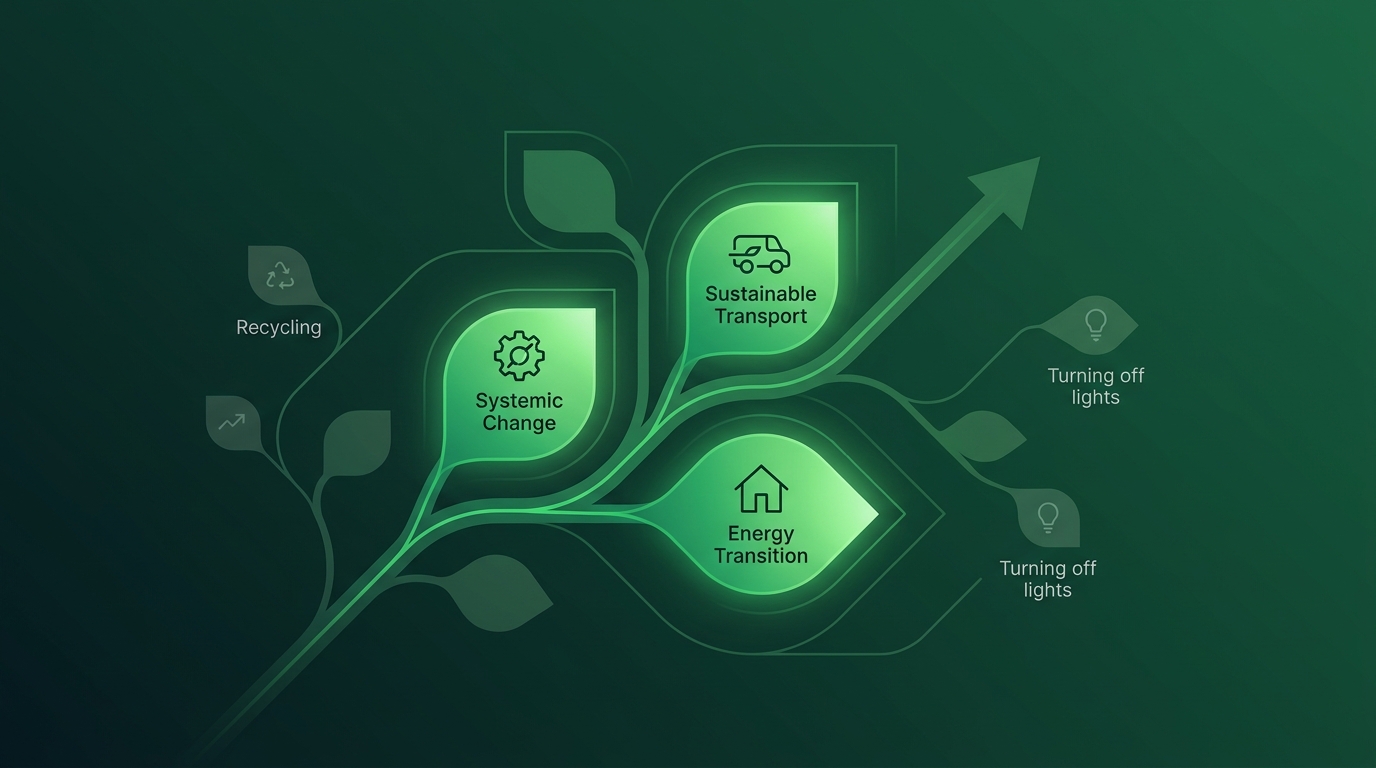
- Why do systemic choices matter more than individual ones?
- FAQ
How to reduce carbon footprint comes down to three categories that dominate the math: home energy, transportation, and diet. Together they account for the large majority of an individual’s emissions in most developed countries, per lifecycle-emissions research from UC Berkeley’s CoolClimate Network and the Intergovernmental Panel on Climate Change (IPCC). Cutting a car commute, switching to renewable electricity, or eating less red meat moves the number far more than recycling, unplugging chargers, or switching off lights ever will.
That doesn’t mean small habits are worthless. It means effort spent on them instead of on the handful of choices that actually carry the weight is effort spent on the wrong problem. This guide breaks down where personal emissions come from, which changes deliver the most reduction per hour of effort, and where individual action reaches its limit and systemic, collective change has to take over.
What counts as your carbon footprint?
A carbon footprint is the total greenhouse gas emissions caused directly and indirectly by a person’s activities, expressed in tonnes of CO2-equivalent (CO2e) per year. It includes direct emissions (driving a car, heating a home with gas) and indirect emissions embedded in what you buy (the manufacturing, shipping, and disposal behind goods, plus the emissions behind the electricity grid you draw from).
The average footprint varies enormously by country: around 17.5 tonnes CO2e per year in the United States, roughly 4.7 tonnes as the current global average, and under 2 tonnes in many lower-income countries, per Our World in Data’s per-capita emissions figures. The IPCC’s 1.5°C pathway implies a global average closer to 2 tonnes per person by mid-century — a useful benchmark for how much reduction is actually needed, not just a directional nudge.
What are the biggest sources of your carbon footprint?
For most households in high-income countries, three categories dominate: transportation (roughly 25-30% of a typical footprint), home energy use (20-25%), and food (10-20%), with the remainder split across goods, services, and air travel for those who fly regularly. This concentration is the single most useful fact for anyone working out how to reduce carbon footprint effectively — it tells you where to spend your first hour of effort, not your fiftieth.
Ranking personal actions by CoolClimate’s household-emissions modeling, the highest-leverage changes are, in order: switching a household’s electricity to a renewable or green-tariff supplier, reducing or electrifying car travel, insulating and heating a home more efficiently, and cutting red meat and dairy consumption. Each of these alone can cut 0.5-2 tonnes CO2e per year for an average household — more than every “everyday habit” combined.
How much does home energy use matter?
Home energy, heating, cooling, and electricity, typically accounts for a fifth or more of a household’s footprint, and it’s also one of the fastest categories to decarbonize without a lifestyle change. Switching to a renewable electricity tariff, installing a heat pump instead of a gas boiler, or adding basic insulation can each cut hundreds of kilograms to over a tonne of CO2e per year, according to CoolClimate’s modeling, with no change in daily routine required once installed.
This is also where “systemic before individual” plays out most clearly: a household on a coal-heavy grid cannot fully green its electricity through behavior alone, its footprint depends heavily on how clean the local grid already is. Renewable-energy projects that expand clean generation capacity move this baseline for everyone on that grid, not just the household that switches suppliers. Keys for Tomorrow’s renewable energy project directory tracks 770+ verified initiatives working on exactly this kind of grid-level change, including projects like NWG Energia‘s 100% renewable energy work and iH2 – Ivoire Hydrogène‘s hydrogen solutions for Africa.
How does transportation compare to other choices?
Transportation is usually the single largest slice of an individual footprint in car-dependent countries, and within it, the choice of vehicle and how often it’s driven matters more than almost anything else measurable at the household level. A daily car commute of 30km can add 1-2 tonnes CO2e per year on its own; replacing it with public transit, cycling, or remote work removes that entirely, while switching from a combustion car to an EV (on a moderately clean grid) cuts it by roughly half to two-thirds over the vehicle’s life, per IPCC transport-sector estimates.
Air travel is the outlier that skews personal totals fastest: a single long-haul round-trip flight can emit close to a tonne of CO2e per passenger, more than an entire year of a typical car commute. For frequent flyers, cutting one long-haul trip does more than months of small daily changes elsewhere.
Sustainable mobility projects, from freight and logistics redesign to alternative vehicle engineering, tackle this at a scale individual choices can’t reach alone. Keys for Tomorrow’s mobility project directory (400+ verified projects) includes examples like Aegean Cargo Sailing‘s sustainable maritime freight across the Mediterranean and Hibra Design‘s efficient vehicle engineering.
How much can diet reduce carbon footprint?
Food typically makes up 10-20% of a personal footprint, and within that, red meat and dairy are disproportionately responsible. Beef has a carbon footprint per kilogram of protein roughly 5-6 times higher than chicken and 10 times higher than beans, according to Our World in Data’s lifecycle-emissions dataset, driven mainly by methane from cattle and land-use change for grazing and feed crops.
Cutting red meat to once a week (rather than eliminating meat entirely) captures most of the available reduction for many households, typically 0.3-0.8 tonnes CO2e per year, without requiring a full dietary overhaul. Food waste reduction adds a second, often-overlooked lever: roughly a third of food produced globally is never eaten, per UN Food and Agriculture Organization estimates, meaning the emissions behind it were generated for nothing.

Which common habits barely move the number?
Recycling, unplugging chargers, using reusable bags, and turning off unused lights are all worth doing, but each typically saves under 20kg CO2e per year, a rounding error next to a single flight or a year of driving. Recycling in particular saves emissions mainly by reducing the energy needed to produce new materials from virgin resources, real, but small relative to the categories above.
The risk with over-indexing on these habits isn’t that they’re wrong, it’s that they can create a sense of having “done the work” on climate impact while the three categories that actually move the number (energy, transport, food) go untouched. Knowing how to reduce carbon footprint effectively means being honest about this gap between effort and impact.
Why reduce your carbon footprint through systemic choices, not just habits?
Individual action has a ceiling: a household can only get its own footprint so low while the grid it draws power from, the food system it buys from, and the transport infrastructure it depends on stay unchanged. Systemic change, cleaner grids, better public transit, lower-emission agriculture, moves the baseline for everyone at once, which is why it delivers more total reduction per dollar or hour invested than personal behavior change alone, per IPCC mitigation-pathway analysis.
This is also where individual choice and systemic change connect directly: buying from, investing in, or simply learning about verified sustainability projects supports the infrastructure that makes low-carbon living the default rather than an effortful exception. Keys for Tomorrow catalogs over 11,300 such projects across 111 countries, sourced and cross-referenced against B Corp, 1% for the Planet, and Solar Impulse Foundation databases, spanning SDG13 Climate Action and the categories covered above. Projects working on sustainable construction and infrastructure, like Gravalock‘s permeable paving systems, and on eco-friendly packaging, like Woola‘s waste-wool packaging, are examples of the systemic layer working alongside individual choices.
Reducing your carbon footprint, in practice, is a mix of both: making the highest-leverage changes available to you personally (energy, transport, diet, in that order), and supporting the systemic work that lowers the baseline for everyone else too. Browse climate-action projects on Keys for Tomorrow to see what that systemic work looks like in practice.
FAQ
What is the single most effective way to reduce carbon footprint?
For most households, switching home electricity to a renewable or green tariff and reducing car dependence deliver the largest reduction per hour of effort, each capable of cutting 0.5-2 tonnes CO2e per year, more than most combined everyday habits.
Does recycling actually reduce carbon footprint?
Yes, but marginally. Recycling typically saves under 20kg CO2e per year for an average household, a small fraction of what a single high-leverage change in energy, transport, or diet delivers.
How much does flying less reduce carbon footprint?
A single long-haul round-trip flight can emit close to a tonne of CO2e per passenger. For people who fly several times a year, cutting even one long-haul trip often outweighs months of smaller daily changes.
Can individual action alone solve the carbon footprint problem?
No. Individual choices have a ceiling set by the systems they depend on, the electricity grid, the food system, transport infrastructure. Supporting or investing in projects that decarbonize those systems compounds the impact of personal changes.

Arnaud Michel is the founder and curator of Keys for Tomorrow. In 2014, his master’s thesis on community currencies and sustainable development won the Prix Recherche at Belgium’s Prix de l’Économie Sociale; the research was later published in Ecological Economics (Elsevier, 2015). He curates this directory to the same standard, cross-checking every project against B Corp, 1% for the Planet, and Solar Impulse Foundation records. Connect on LinkedIn.