What is the Project?
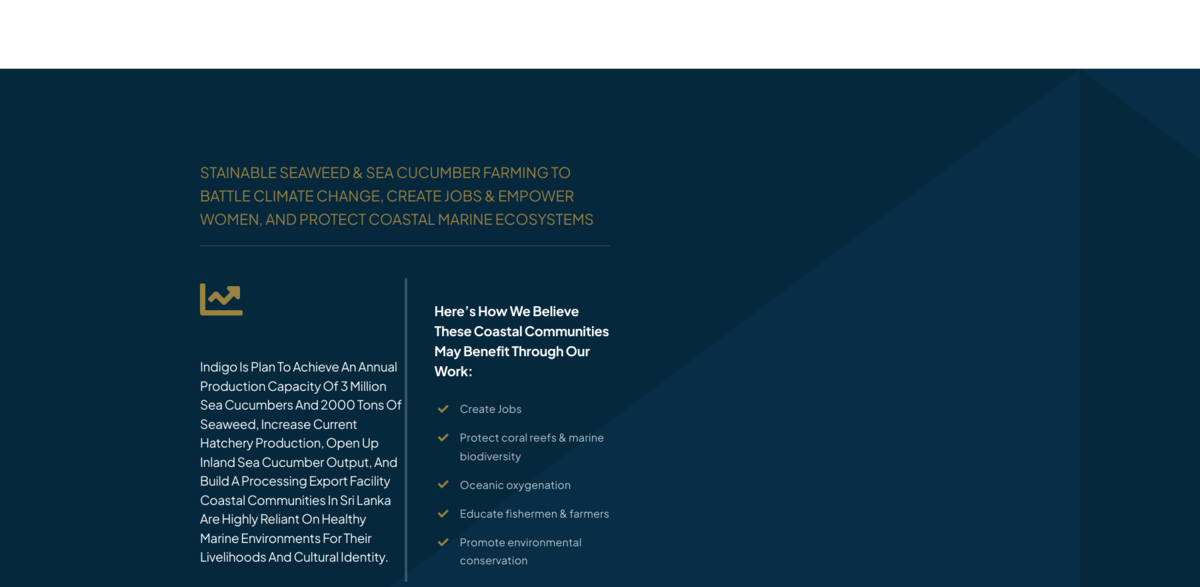
SUSTAINABLE SEAWEED & SEA CUCUMBER FARMING TO BATTLE CLIMATE CHANGE, CREATE JOBS & EMPOWER WOMEN, AND PROTECT COASTAL MARINE ECOSYSTEMS. This ambitious initiative focuses on harnessing nature’s own resources to foster a productive and balanced marine environment… The project is anchored in a visionary plan that seeks to achieve an annual production capacity of 3 MILLION SEA CUCUMBERS AND 2000 TONS OF SEAWEED. INDIGO IS PLAN TO ACHIEVE AN ANNUAL PRODUCTION CAPACITY OF 3 MILLION SEA CUCUMBERS AND 2000 TONS OF SEAWEED, INCREASE CURRENT HATCHERY PRODUCTION, OPEN UP INLAND SEA CUCUMBER OUTPUT, AND BUILD A PROCESSING EXPORT FACILITY. COASTAL COMMUNITIES IN SRI LANKA ARE HIGHLY RELIANT ON HEALTHY MARINE ENVIRONMENTS FOR THEIR LIVELIHOODS AND CULTURAL IDENTITY. Every element of the plan underscores a deep respect for marine life while paving the way for sustainable progress.
Main Benefits of the Initiative
The project outlines a clear vision for coastal upliftment and environmental balance. It offers extensive advantages that resonate not only at an environmental level but also through tangible socio-economic improvements. Key figures and facts speak loudly:
- Create Jobs
- Protect coral reefs & marine biodiversity
- Oceanic oxygenation
- Educate fishermen & farmers
- Promote environmental conservation
Each bullet point represents a cornerstone benefit. These points illustrate how sustainable aquaculture can make a difference—ranging from generating new work opportunities to preserving the delicate balance of coral reefs and maintaining marine oxygen levels.
Challenges in Coastal Ecosystems
THE NUMBER OF SEA CUCUMBER SPECIES IN SRI LANKAN COASTAL WATERS HAVE DIMINISHED OVER RECENT YEARS, OWING TO CORAL REEF DESTRUCTION, OVER-FISHING AND A LACK OF COMMERCIAL HATCHERIES AND FARMS TO MEET HIGH DEMANDS. THIS POTENTIATES A VICIOUS CYCLE AND FURTHER ENDANGERS THESE VALUABLE SPECIES. BUT ALSO OFFERS AN INCREDIBLE OPPORTUNITY. The degradation observed in marine habitats is not merely an environmental concern—it reflects a cascading effect on local communities that rely on these ecosystems for cultural and economic sustenance. Observers note that the decline in sea cucumber species has become a wake-up call, encouraging a reevaluation of fishing practices and habitat maintenance… urging policymakers to invest in restoration and sustainable aquaculture practices.
Innovative Farming Strategies
The project leverages innovative farming strategies that combine modern techniques with age-old ecological wisdom. By increasing current hatchery production and tapping into inland sea cucumber output, the initiative demonstrates a practical approach to sustainable seafood production. The plan to build a processing export facility reinforces the vision of creating value-added products that can reach global markets. This approach not only revitalizes traditional practices but also modernizes them, ensuring that both technology and nature work in unison. The methodology exudes a sense of forward-thinking, where each step taken is both deliberate and adaptive to the dynamic needs of coastal environments.
Empowering Coastal Communities
Coastal communities in Sri Lanka benefit significantly from projects that are anchored in sustainable aquaculture. Embedded in the vision is the acknowledgment of pressing issues such as poverty and limited employment opportunities, especially for women in coastal areas. The project’s focus on empowering women—coupled with its commitment to job creation—nurtures a more equitable social structure. Educational initiatives that target fishermen & farmers complement these employment efforts, ensuring that knowledge and skills are passed on, thus laying the groundwork for a resilient economy. The drive to promote environmental conservation is closely interwoven with a commitment to community upliftment… creating a roadmap for a future where livelihoods and nature coexist harmoniously.
Project Impact on Sustainable Development Goals
- SDG 5: Gender Equality – Empowering women in coastal communities
- SDG 8: Decent Work and Economic Growth – Generating jobs and boosting local economies
- SDG 13: Climate Action – Taking bold steps to confront climate change
- SDG 14: Life Below Water – Protecting coastal marine ecosystems and biodiversity
The alignment with these Sustainable Development Goals (SDGs) highlights the multifaceted benefits of the project. Each goal has been carefully chosen to reflect critical components—from enhancing economic opportunities to fostering environmental resilience. The interconnected nature of these goals underscores a unified vision where sustainable development is integral to community well-being.
Future Prospects and Vision
Looking ahead, the sustainable seaweed and sea cucumber farming project stands as a bold vision for the future of coastal ecosystems and community development in Sri Lanka. The drive to substantially increase production capacity—it’s all part of a master plan that seamlessly blends environmental priorities with socio-economic upliftment. The strategy to open up inland sea cucumber output and develop an export facility indicates that the project is set on creating a lasting impact. This forward-thinking vision embraces both tradition and modernity, ensuring that marine conservation efforts are sustained for generations. With high emphasis on protecting coral reefs & marine biodiversity and generating new employment opportunities, the project paves the way for a vibrant and sustainable future… a future where coastal communities can thrive in harmony with the resilient rhythms of nature.
What Indigo Aqua actually does
Indigo Aqua farms seaweed and sea cucumbers along the Sri Lankan coast, working in coastal communities with over 10 years of development in the area. The company is targeting an annual production capacity of 3 million sea cucumbers and 2,000 tons of seaweed, exporting Sri Lankan sea cucumber and seaweed products.
Where the farming shows up
- Sea cucumber aquaculture: hatchery-based farming aimed at scaling to 3 million sea cucumbers a year.
- Seaweed farming: coastal seaweed cultivation targeting 2,000 tons of annual production.
- Coastal community jobs: farming operations designed to create local employment, including for women, in Sri Lankan coastal communities.
Why this belongs on a sustainability directory
Indigo Aqua connects to SDG 14 (life below water) by farming seaweed and sea cucumbers in ways intended to support coral reef and marine biodiversity protection, SDG 1 (no poverty) through job creation in coastal communities, and SDG 5 (gender equality) through its stated focus on employing women in its operations.
Frequently asked questions
Where is Indigo Aqua based, and who uses it?
Indigo Aqua operates in coastal communities in Sri Lanka, with over 10 years of development work in the area. It exports sea cucumber and seaweed products internationally.
Which SDGs does Indigo Aqua support, and how?
Indigo Aqua supports SDG 14 (life below water) through sustainable seaweed and sea cucumber farming aimed at protecting coral reefs and marine biodiversity, SDG 1 (no poverty) through coastal job creation, and SDG 5 (gender equality) through employment opportunities for women.
How is Indigo Aqua verified as a sustainability project?
Indigo Aqua holds Solar Impulse Efficient Solution certification.
Looking for similar Conservation & Biodiversity projects?
See Conservation & Biodiversity projects on Keys for Tomorrow.