Project Overview: Sinai Slums, Industrial Area, Nairobi
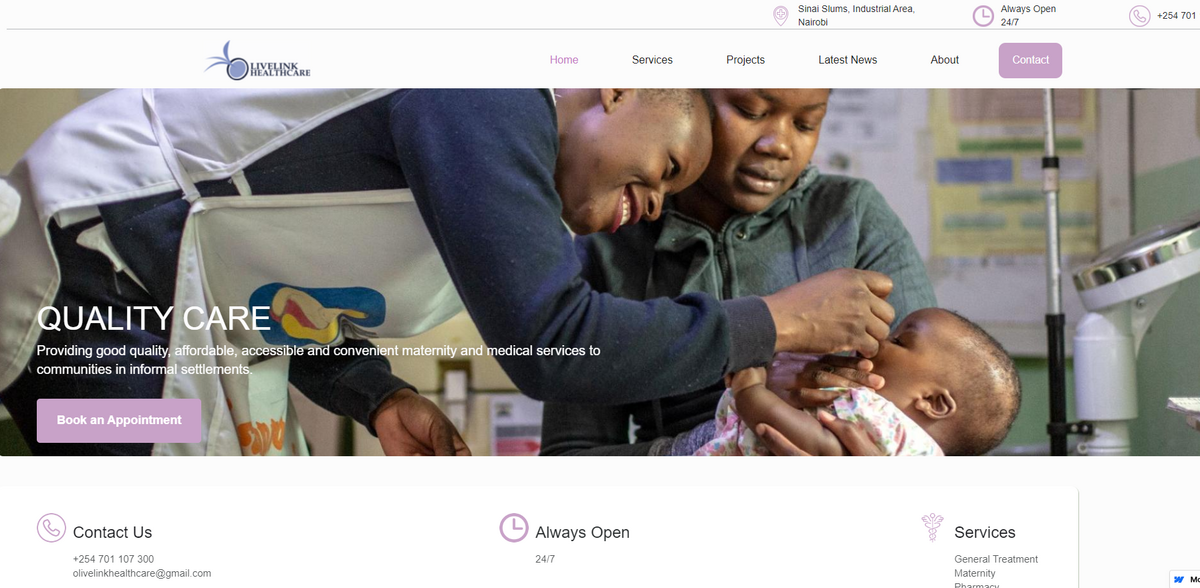
Sinai Slums, located in the Industrial Area of Nairobi, stands as a beacon of quality care in a challenging environment. Always open 24/7, this facility offers accessible and affordable maternity and general medical services to communities situated within informal settlements. The core promise is simple yet impactful – to provide good quality, affordable, accessible, and convenient maternity and medical services to the community. Contact details like +254 701 107 300 and olivelinkhealthcare@gmail.com ensure that help is never far away. The service ethos exudes a commitment to excellence, supporting the vision of providing quality patient-centered healthcare services throughout East Africa’s informal settlements.
Main Benefit: QUALITY CARE
The hallmark of this initiative is its unwavering focus on QUALITY CARE that really makes a difference. Key figures and facts spotlight its outstanding achievements:
- 20,020 ANTE-NATAL CARE VISITS
- 716 ULTRA SOUNDS DONE
- 4,791 SAFE DELIVERIES
- 5,164 FAMILY PLANNING
- 43,646 IMMUNIZED BABIES
- 5,776 POST NATAL FOLLOWUPS
- 68,887 MEDICAL CASES TREATED
- 700,000+ TOTAL LIVES IMPACTED
Maternity & Medical Services
The project provides a spectrum of services carefully curated to meet pressing healthcare needs. The facility’s maternity services deliver a hands-on and dignified support system for expectant mothers during the birthing process. Expectant mothers can rely on the comfort, privacy, and even a delicious diet offered during their stay… ensuring that the birthing experience is both safe and nurturing. General treatment services are designed to cater to the entire family at outpatient consultation sessions that promise fast, efficient service with short waiting periods. These efforts contribute to a healthcare experience that is as proactive as it is empathetic.
Comprehensive Out-Patient Consultation
The foundational aspect of the project is embodied in its out-patient consultation services. These services ensure that families can access reliable and prompt medical care without lengthy delays. Over time, the initiative has built a reputation for driven service excellence. Patients from all walks of life benefit from consultations that are both timely and informed by the highest possible standards, delivered through a thoughtful blend of qualified staff and well-maintained equipment. The commitment extends to bridging gaps in access where healthcare is most needed, making each visit not just a consultation but a step toward better wellness.
Accessible Pharmacy Services
An essential component of the health initiative is the in-house pharmacy, ensuring that patients receive immediate access to their prescriptions. This convenience eliminates the need for patients to travel to distant outlets in search of essential medication. With the pharmacy well-stocked, medical supplies and drugs are readily available, fitting seamlessly into the model of accessible, continuous care. This integration reflects a holistic approach to healthcare, one where consultation, treatment, and medication procurement all converge in one location.
Project Impact and Associated SDGs
- SDG 3: Good Health and Well-Being
- SDG 1: No Poverty
- SDG 10: Reduced Inequalities
Community Outreach and Vision for the Future
The broader vision of the project is to continuously improve the quality of life by delivering timely, quality, and affordable healthcare services to patients and their families. Each day, efforts are made to uphold this mission through a rigorous standard maintained by highly qualified staff and ongoing training programs. The commitment to quality is evident in the project’s regular operations: providing general treatment, maternity care, and medication fulfillment all under one roof. This strongly patient-centered approach makes a real-world difference among communities living within informal settlements. Over time, the initiative’s impact has rippled outwards, touching the lives of over 700,000 individuals, a testament to its adaptability and unwavering service ethos.
Structured around a community-first strategy, the project brings together professional medical service delivery and community engagement. The philosophy is clear: affordable and accessible healthcare should not be a luxury but a fundamental right. By embracing dynamic change with the right mix of quality care and rapid responses, this initiative continues to build trust. It adapts to evolving patient needs while ensuring that the essentials – like timely consultation, dignified maternity care, and complete pharmaceutical support – are not compromised. This continual evolution is rooted in the desire to see patients thrive and communities become more resilient. In essence, it’s a journey that goes beyond healthcare: it is about nurturing a healthier, more equitable future for everyone.
What Olivelink Healthcare actually does
Olivelink Healthcare runs a 24/7 outpatient, maternity and pharmacy facility in the Sinai informal settlement, Industrial Area, Nairobi. Its stated aim is to offer “good quality, affordable, accessible and convenient” maternity and medical care to people living in informal settlements, with general consultations for whole families, in-patient care, dental care and an on-site pharmacy so patients can fill prescriptions without leaving the facility.
Founder and CEO Josephine Suleiman built the model around maternal health. Mothers are supported through antenatal visits, delivery, postnatal follow-up, family planning and infant immunization, with an emphasis on privacy, dignity and meals during the mother’s stay. Two community projects extend this: the Baby Care Box, a portable carton that doubles as a cot for the first six months plus newborn supplies, and the Mama Mimba Fitness Programme for expectant mothers, launched in January 2022.
Where Olivelink Healthcare shows up
- Expectant mothers in informal settlements: antenatal care, safe delivery and postnatal follow-up close to home, open around the clock.
- Families on low incomes: affordable outpatient consultations with short waiting times and an in-house pharmacy.
- Newborns: immunization plus the Baby Care Box, which gives babies a safe sleeping space in their first six months.
Proof, not just claims
Olivelink’s website also reports 20,020 antenatal care visits and 5,164 family planning cases. Its own Baby Care Box data for 2022 to 2023 shows that of 750 mothers at a first antenatal visit, only 11% started care in the first trimester, the gap the programme is designed to close.
Why this belongs on a sustainability directory
Olivelink notes that maternal and infant mortality in informal communities runs at 1.5 times Kenya’s national average. By putting skilled delivery, antenatal and postnatal care, immunization and family planning inside the settlement itself, at affordable prices and 24 hours a day, it targets SDG 3 directly: reducing maternal and newborn deaths and widening access to essential health services for people that formal hospitals often fail to reach.
Frequently asked questions
Where is Olivelink Healthcare based, and who uses it?
Olivelink Healthcare is based in the Sinai informal settlement, Industrial Area, Nairobi, Kenya, and was founded by Josephine Suleiman. Its patients are mainly mothers, babies and families living in Nairobi’s informal settlements who need affordable outpatient, maternity and pharmacy services.
Which SDGs does Olivelink Healthcare support, and how?
It supports SDG 3, Good Health and Well-being, by providing antenatal care, safe deliveries, postnatal follow-up, infant immunization, family planning and general medical care in a community where maternal and infant mortality is well above the national average.
How is Olivelink Healthcare verified as a sustainability project?
Olivelink does not list a formal certification. The evidence is its operating facility and the service figures it publishes on its own website, including 4,791 safe deliveries and 43,646 immunized babies, plus a profile by Santa Clara University’s Miller Center for Social Entrepreneurship, which lists it as established in 2013.
Looking for similar Health & Well-being projects?
See all Health & Well-being projects on Keys for Tomorrow.