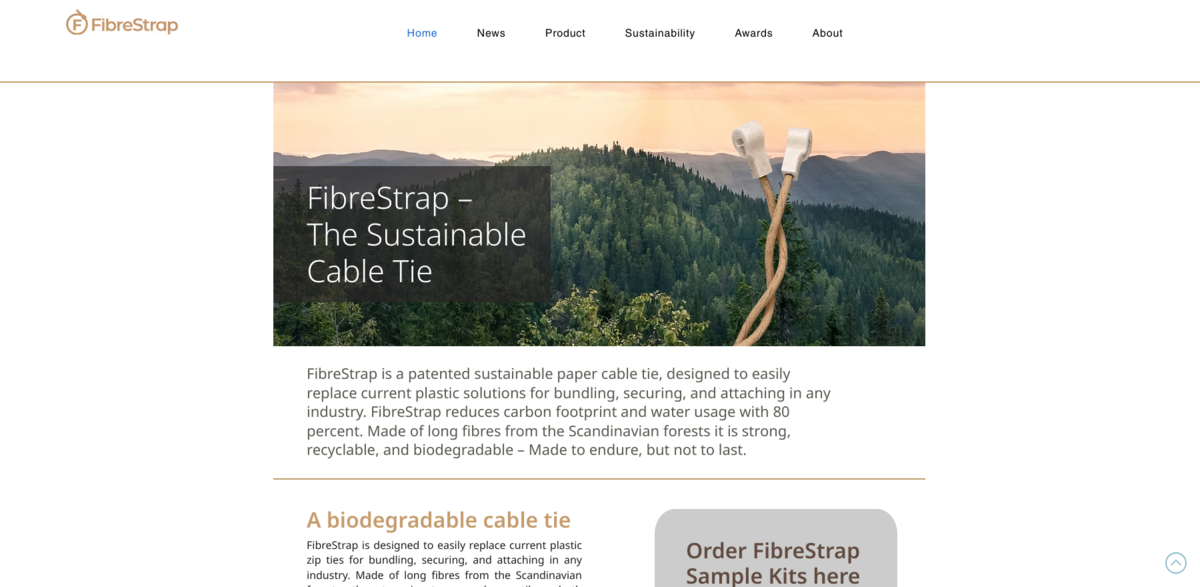
What is FibreStrap?
FibreStrap is a patented sustainable paper cable tie designed to easily replace current plastic zip ties used for bundling, securing, and attaching in any industry… Made of long fibers from the Scandinavian forests, this innovative cable tie is strong, recyclable, and biodegradable – made to endure, but not to last. The project emphasizes sustainability by reducing carbon footprint and water usage by 80 percent, transforming everyday industrial practices into environmentally responsible solutions.
Main Benefits
The sustainable benefits of FibreStrap stand out with impressive figures that make a real impact:
- More than 85% CO2 reduction
- More than 80% water reduction
- Minimum of 85% renewable sources
- Tensile strength of 110N in compliance with IEC 62275:5:2018
- Recyclable and biodegradable design
Uncompromised Performance
FibreStrap has been rigorously tested and validated according to the Type 2 test – the standard for plastic cable ties. With its demonstrated tensile strength of 110N in compliance with IEC 62275:5:2018, it ensures reliable performance for hanging, securing, attaching, sealing, and bundling just about anything. Tested under conditions that mimic everyday industrial demands, the cable tie offers the same performance reliability as traditional solutions, but without the environmental burden.
Recycling and Sustainable Material
One of the remarkable features of FibreStrap is its repulpable nature. This means the cord material can be transformed into new paper, aligning with responsible recycling practices and contributing to a circular bio-economy… While recycling regulations may differ by country, FibreStrap is generally eligible for inclusion in paper recycling streams, provided that the fiber content exceeds 95%. Such flexible recyclability is an important part of its design, ensuring it is as kind to the planet as possible.
Innovative Renewable Design
FibreStrap is crafted from renewable materials sourced from certified wood fibers in Scandinavian forests. Being a minimum of 85% plant-based, the cable tie is built from natural resources that can be replenished generation after generation. The design intentionally minimizes waste and pollution while championing a move towards a circular bio-economy. In sectors where plastic remains ubiquitous, FibreStrap provides a sustainable alternative that reduces CO2 emissions, water consumption, and the reliance on fossil fuel-derived plastic.
Project Impact
- SDG 12: Responsible Consumption and Production
- SDG 13: Climate Action
- SDG 14: Life Below Water
- SDG 15: Life on Land
Future Outlook for Sustainability
EVLR, the Swedish company behind FibreStrap, is at the forefront of developing, manufacturing, sourcing, and selling solutions to protect, seal, fasten, and collect products, always keeping sustainability in heart and mind… With a vision of contributing to a better environment and plastic-free oceans, FibreStrap is more than just a product – it’s a step towards a more sustainable future. Its innovative design not only meets rigorous performance standards but also redefines what’s possible when renewable materials and responsible production practices come together. FibreStrap symbolizes the intersection of performance and sustainability, driving the industry forward with a clear commitment to reducing environmental impacts in every application.